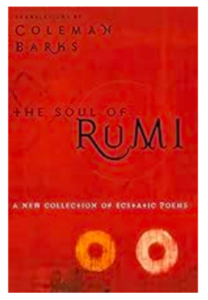
Book Review: The Soul of Rumi, translations by Coleman Bark
I. Author’s Bio

Jelaluddin Rumi (1207-1273) lived his young life in Balkh, Afghanistan
which was then part of the Persian Empire. When Rumi was a young
man, his family moved to Konya, Turkey just ahead of the invading armies
of Genghis Kahn. Rumi’s father Bahauddin Walad was a theologian, an
instructor of Dervish (the Sufi Path), and a mystic. Rumi was a student of
his father. When his father died an advanced student Burham Mahaqqiq
took it upon himself to teach Rumi. Burham was a meditator from the
north east mountain area of Konya. For nine years he taught Rumi the
mystical tradition of fasting. During this time Rumi began to write poetry.
In the year 1244 Rumi met Shams of Tabriz. At this meeting Rumi’s new
life began. He said “What I had thought before as God I met today in a
human being.” Rumi met his Perfect Master Shams of Tabriz. In his
poetry he calls Shams “Friend”. Rumi also became a Perfect Spiritual
Master, most likely at the time of Shams’ death. Shams and Rumi were
united as One.

Rumi’s poetry is deep. He describes the mundane, and the exciting,
experiences of daily life and guides the reader to penetrate the surface to
relish the subtle mystical realities of our lives. His theme is always about
God. His poetry causes the reader to search for the Friend. However one
might read his poetry, it always leads to the path to God, if one has the
desire to find God. Rumi opens the majestic imagination. The reader finds
questions and answers. Rumi teaches how to open the heart. His poetry
is about love, Love is Spring. Love is wine. Love is the nausea that comes
from wine! Love is longing for the Friend.

Rumi’s grave shrine is in Konya, Turkey.

II. Relationship to Quaker Testimonies


1. Peace: “Listen to your essential self, the Friend: when you feel longing,
be patient, and also prudent, moderate with eating and drinking. Be
like a mountain in the wind.” (page 190)

2. Equality: “In the ocean there are many bright strands and many dark
strands like veins that are seen when a wing is lifted up. Your hidden
self is blood in those, those veins that are lute strings that make ocean
music.” (Masnavi IV)

3. Simplicity: “Taking time for ritual prayers and meditation saves time.”
(page 76)


4. Truth: “...call it reason or discernment, you have within you a deciding
force that knows what to receive, what to turn from.”
(Page 170)
III. Peace Testimony

“When you do things from your soul, you feel a river moving in you, joy.”

(Page 79)